
Painting, Street Life and Digital Experiments
Follow a surface, a place and a change of role. Those three routes connect the watercolours, city project and web museum discussed here more clearly than a list of media alone.
The artist’s account and three points of reference
In her historical gallery introduction, Anjali Arora describes herself as a self-taught painter influenced by nature, French Impressionism and street life. She connects Ahmedabad, New York and memories of Mumbai, and mentions study at NYU’s Interactive Telecommunications Program. The gallery includes watercolours and digital prints among its sections. The watercolour captions document Wine Bottles and White Trees; the 3D project account identifies a painting reused as texture in My Two Worlds. The 2001 web museum gives paintings speaking roles. These are distinct works and formats, brought together here for a current editorial comparison.
A small working catalogue
Wine Bottles: a familiar object as a light problem
Begin with Wine Bottles. Its caption identifies light as part of the subject. A reading can therefore distinguish recognition—knowing that an object is a bottle—from description: explaining how colour, boundaries and surrounding space make that object present. The watercolour readings compare colour, direction and visual weight, with the separate object records still linked.
Purple Flowers: look at the gaps
Violet patches cluster among green stems, but the pale ground keeps breaking through. Follow those interruptions in the watercolour guide: the plant reads as a crowded growth without acquiring one clean outer edge. A useful comparison with White Trees starts with these gaps and directions, rather than stopping at the fact that both pictures concern plants.
White Trees: the ground answers the trunks
The pale trunks provide upright accents, while short light marks and brown patches move across the ground. The right side feels more gathered. In the close reading of White Trees, those directions give the tree picture a structure beyond its subject. The caption supplies the occasion after rain; it does not do the looking for us.
My Two Worlds: painted material enters a moving view
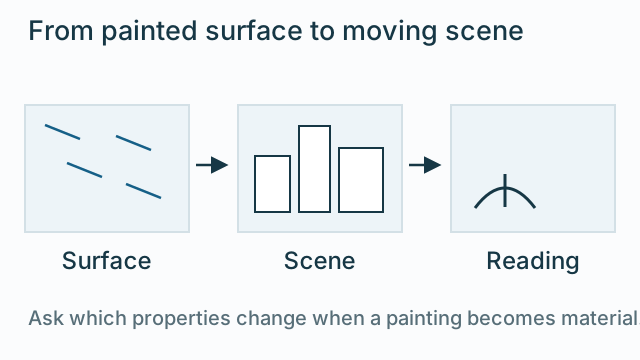
In My Two Worlds, painted material takes on an environmental role. Follow the distinction between the source painting and the texture derived from it: a surface designed for a fixed composition can participate in a scene encountered over time. The change of medium introduces viewpoint, sequence and sound as additional decisions.
Welcome to the Met: paintings become social actors
Welcome to the Met makes a different transition. Its pictures become characters whose preferences affect how we understand the museum. Compare a painting’s physical surface with its fictional role: one offers something to look at, while the other creates a position from which looking itself can be criticised.
What the comparison makes visible
These examples suggest three distinct continuities rather than a single story of technical progress. Surface can migrate between media. A place can be approached through a selected contrast or remembered sound. A picture can be treated as an object, an environment’s material or a speaking participant.
Use those distinctions when moving through the work. Ask what has been carried forward and what the new form adds. A digital project need not replace painting to extend one of its questions, and a painting need not anticipate an interface to reward close attention.
For another treatment of material and structure, continue to repetition, segmentation and differentiation. Its worked examples focus on how a simple rule can produce a readable form.