
ArchChive: “My Tasks” Is a Different Question
Personal responsibility and days overdue: those two details in the response labelled “Paul s” make a sharper brief than “visual project management”. A list of tasks is useful only after it answers whose work is at issue.
An invitation and one answer
On 3 April 2005, Anjali Arora’s testing invitation described a collaborative project-management prototype at this address and asked readers to compare visual data presentation with text lists. The 18 April entry, “User response Paul s,” lists information priorities for a team member and a project manager.
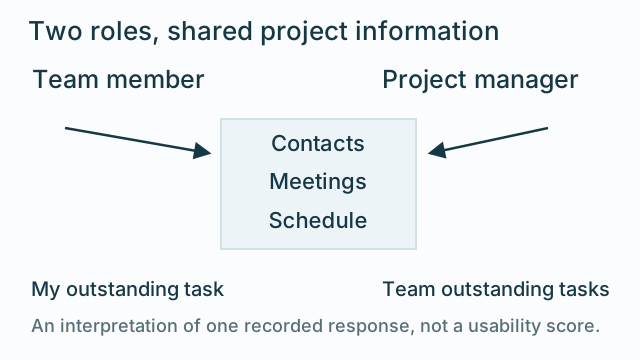
Contacts, meeting calendar and schedule appear before outstanding tasks and newly posted documents. The member response specifies personal responsibility and days overdue; document entries need the poster and timestamp. A picture of the project cannot substitute for those relations.
The word “my” changes the selection
A team member needs to separate a personal commitment from the team’s workload. A manager needs to see across owners. These views can share the same records while selecting different outstanding tasks. I find that distinction more useful than a contest between pictures and text: it gives a proposed display something exact to preserve.
Do not let urgency consume the dashboard
Outstanding work is an obvious visual subject: it invites markers, colour and prominent numbers. Yet the response ranks contacts, calendar and schedule ahead of it. An overdue marker needs the person and time that give it meaning. A view that removes those quieter categories could become more dramatic while answering less of the brief.
The same applies to new documents. A thumbnail shows something about appearance. The poster and timestamp answer different questions: who supplied this, and how recent is it? The response asks for both. Visual treatment can organise those details; it cannot replace them.
Record note
One response supplies requirements to investigate. The surviving entries do not establish recruitment, participant numbers, completed tasks, completion times, error counts or a measured advantage for the prototype. No original interface or successful study is reconstructed here.