
ArchChive: Dates, Importance and a Spiral of Files
A project’s newest file and its most important file need not be the same thing. Anjali Arora’s saved ArchChive proposal tries to make both visible: colour and position carry a file’s date, while scale carries its user-defined importance.
An architect’s file collection
The page captured on 6 April 2007 describes a proposed collaboration and file-sharing tool for architects. Photos and sketches would sit alongside other project files, with annotations intended to keep a group’s understanding together. Arora wanted an alternative to a text table, combining information visualisation with an emotional response to the display.
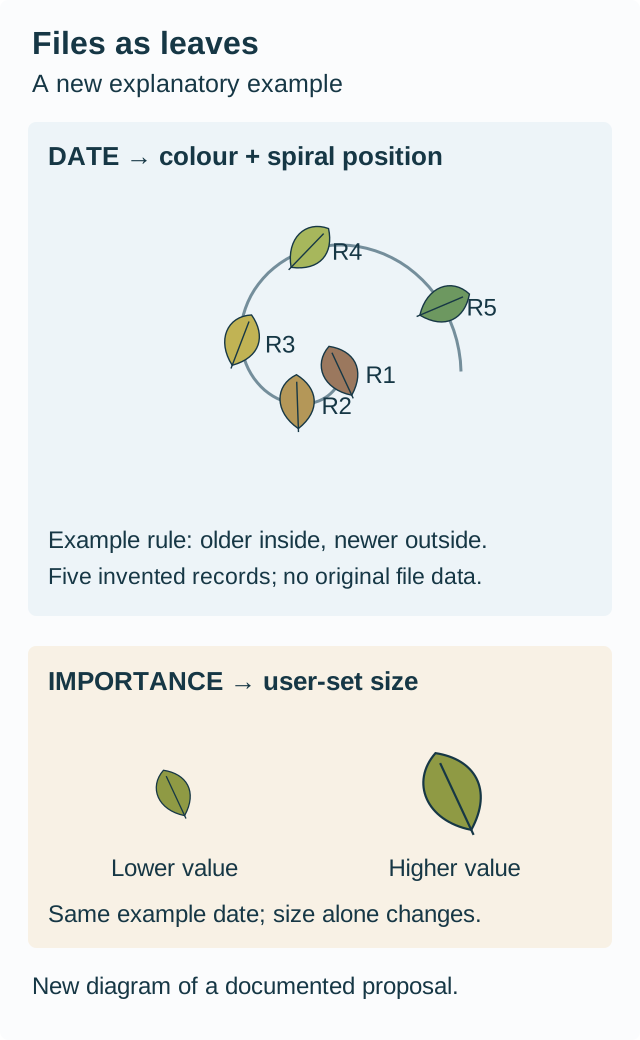
Its central metaphor comes from leaves. A file becomes a visible leaf; the leaf’s colour and place on a spiral indicate its date. Its size expresses an importance value assigned by a user. The saved page links separate design-goal, metaphor, scenario and prototype documents. It establishes a specific proposal, rather than a demonstrated improvement in finding files.
Keep the three decisions separate
Identity: the leaf stands for a file. It supplies a repeatable unit, but it still needs enough identifying information to distinguish one document from another.
Date: colour and spiral position describe the same property through two visual channels. A reader needs their shared rule. Without it, an outer leaf might look newer, older or simply farther away. The original account identifies the property; the new diagram above chooses its own clearly labelled example direction.
Importance: scale introduces a different judgement. A large old file and a small new file should remain possible. Treating size as another sign of recency would erase the distinction the proposal makes.
The examined original interface thumbnail shows dated leaves on a spiral. It is a 200 × 186 pixel image captured on 11 March 2007. It supports a reading of that display, not a claim that the complete collaboration system runs here.
Why a Goldsworthy article points here
The 19 February 2007 article about Andy Goldsworthy wraps a photograph of a leaf sculpture in a link to infodesign.htm?id=smenu4. The same 356 × 388 pixel JPEG survives in Artbrush’s archived sculpture image; the two downloaded files are byte-identical. The historical Artbrush page identifies Goldsworthy as the inspiration for its leaf metaphor.
The query parameter has a more ordinary job than the photograph might suggest. In the captured HTML and script, smenu4 is the navigation group containing Info Design, Photo-sharing and Mobile Applications. The parameter opens that group; it is not an identifier for a recovered image viewer. The original photograph remains at its linked sources.
When a metaphor becomes a design rule
I find the date–importance distinction more useful than the promise of a natural-looking desktop. A visual metaphor earns its place when its parts carry stable meanings. The spiral asks a concrete question: can a person separate when a file arrived from why it matters?
The saved design does not answer that question with measured retrieval results. A test would need named files, agreed date and importance values, a retrieval task and a record of what people chose. Until then, the mapping is an inspectable design proposition. Compare the recorded role requirements for ArchChive and the separate audience-and-stage study, which draws on another portfolio case.
Sources
- Original information-design page, captured 6 April 2007.
- Original interface thumbnail, captured 11 March 2007.
- Sculpture photograph credited to Goldsworthy in the original page, captured 11 March 2007.
- Andy Goldsworthy: Rivers and Tides — referring article, 19 February 2007.


The current reading and explanatory diagram belong to this edition. Historical source files have been recovered for examination; the original artwork, prototype runtime and permission to republish historical images are separate questions.