
Art Links: Find a Work, Compare Its Record
Choose a catalogue by the question you need to answer. A comparison index, an author-based gallery and an artist’s own page describe different relationships. These three tasks show how to move between them without treating a changed title as a different work or a catalogue description as a record of every interaction.
The source records serve different purposes
Whitney Artport’s Idea Line text index lists artworks with fields for artist, title, URL, year, keywords, technologies and description. It includes the Artbrush addresses for /prix/, /wvf/ and /cynetart/, under titles that differ from this site’s current guide headings. The preserved trAce Assemblage catalogue at The NEXT groups entries by author; its Arora entry includes Urban Lullaby and other Artbrush works. The August 2015 capture of Artbrush’s links page is a broader artist directory with reciprocal-link instructions. It records an earlier directory-building practice, rather than supplying the selection criteria for this current guide.
One address, three museum titles
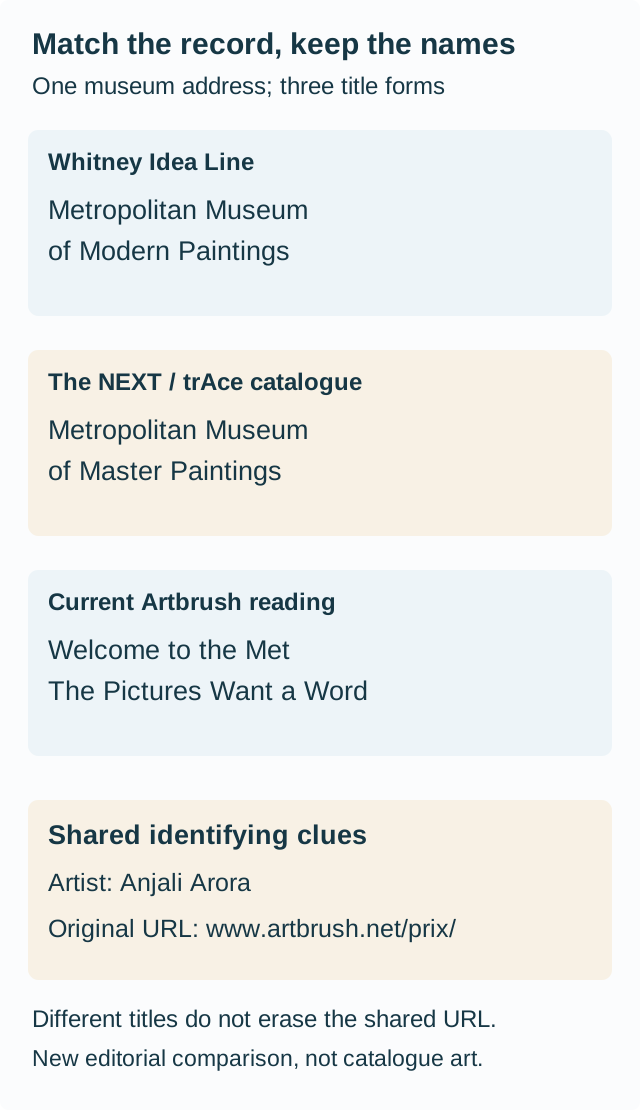
Start with the museum project. In Whitney’s index, find the Arora entry pointing to www.artbrush.net/prix/. The catalogue title is Metropolitan Museum of Modern Paintings; this site’s guide is Welcome to the Met. In The NEXT’s Arora entry, the same address appears under Metropolitan Museum of Master Paintings.
The worked match rests on the author and original URL, with the title variation preserved in the note. A useful research note reads: same original address; catalogue titles vary; current guide heading differs. Do not silently standardise all three names and erase evidence of how the work circulated.
A keyword is a starting point
Use Whitney’s adjacent fields to choose a comparison, then open the relevant project guides. For the museum work and Nothing Is Impossible Out Here, ask one narrow question: what role does the visitor take, and what action moves the encounter forward?
For the museum and Nothing Is Impossible Out Here, the catalogue makes discovery possible, while the saved pages establish different actions: choosing a gallery scene and revealing a concealed reply. A shared keyword does not make those encounters equivalent. The reading guide explains how a catalogue, a captured page and an actual runtime answer different questions.
Follow an artist, then inspect a gesture
For a focused route into Urban Lullaby, use The NEXT’s author grouping to locate Arora, then compare the entry with the source-based guide here. Record which description concerns the work’s theme and which evidence establishes an actual control. The guide’s three image-swap triggers answer a different question from a catalogue’s summary of urban sound.
How this selection was made
These starting points have named institutional or curatorial contexts, identifiable records and a direct connection to the projects discussed here. Their value is the task each supports: compare catalogue fields, trace an author’s works or inspect historical directory practice. A long list of loosely relevant home pages would make those choices harder.
For opportunities and reusable research material, use artist resources; that guide starts from the deliverable you need rather than from an artwork title.