
Reading Early Web Art: A Worked Route
A web artwork can distribute its meaning across an entrance, a room and a small response to the pointer. Reading it closely starts with a modest task: record what is visible in each part before combining the parts into an interpretation.
The route below uses three preserved pages from Welcome to the Met. It gives a finished example of a research note, followed by a method you can apply to another project.
Step 1: name the object you are examining
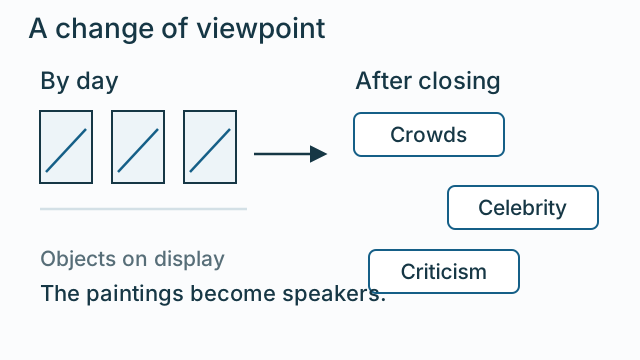
The saved daytime Gallery 1 introduces paintings labelled as dating from around 1542. The night-time introduction changes the premise: the paintings acquire lives after closing. In the Gallery 1 conversation, their talk moves through crowds, celebrity and fashionable criticism.
These are three different pieces of evidence. The date attached to a saved page identifies that capture. The date attributed to a painting inside the work is a statement made by the work. Keeping those two fields apart prevents a research note from silently treating them as the same kind of fact.
Step 2: finish one comparison
- Observation
- The daytime page presents objects to a visitor; the later conversation makes objects the speakers.
- Interpretation
- The shift lets a museum's usual subjects look back at the people judging them.
- Check
- Return to a particular exchange and identify which speaker supports that reading. A general impression alone is insufficient.
The observation names a change you can locate. The interpretation proposes why that change matters. The check gives another reader a way to disagree productively. This compact structure is more useful than a note saying only that the work is interactive or humorous.
Step 3: record the route, not only the entrance
Save the title, creator, original address, capture date and the specific scene used. Add a sentence recording which text, images and controls you could inspect. A scene that loads today may differ from another saved version, so include the version you actually used in your citation.
For a time-based work, record the sequence as well as the source address. The GIF close reading links the examined file and explains its declared timing. For a design prototype, distinguish a proposed mechanism from an observed response; ArchChive works through that distinction using a participant record.
A reusable note template
- Source: creator, title, original address and capture.
- Observed detail: one scene, object or control you can point to.
- Reading: what that detail contributes to the work.
- Boundary: an unavailable part or an alternative explanation that the note does not settle.
Apply the same structure to Urban Lullaby or the watercolour guide. The catalogue comparison shows how to match variant titles, and the editorial desk accepts corrections to the present guides.
Sources
- Gallery 1 by day — capture of 20 July 2001
- Night-time introduction — capture of 5 May 2001
- Gallery 1 conversation — capture of 11 September 2001
The comparison and note template are current editorial teaching material.