
Watercolours: Three Ways to Make a Place
The pale trunks in White Trees gather on the right. Across the ground, small light strokes interrupt a broad spread of rusty brown. Before the picture offers a view to travel through, it gives the eye a contrast to settle on.
That is a better starting point for this group of watercolours than a general claim about atmosphere. Three surviving images let us look at three quite different arrangements: a ground broken by pale trunks, a dense stand of flowers, and a bed that fills a room.
White Trees: the ground does half the work
Open examined image: White Trees450 × 222 pixels · capture 17 February 2004 · opens archival source in a new tab
The trunks are easy to name. Their pale surfaces and dark horizontal markings pull them forward. Yet the ground gives them much of their force. It is crossed by short, light marks and patches of brown that keep it active rather than turning it into a flat background.
Notice how much more gathered the right side feels. The trunks provide upright accents; the ground answers with strokes running across the picture. The difference in direction holds the scene together without making every part equally busy.
The historical gallery caption connects the painting with pale bark and red-brown, twig-covered ground after rain. The saved image makes that comparison available to inspect. The caption supplies the occasion; the contrast supplies a way into the painting.
Purple Flowers: a crowd with no clean outline
Open examined image: Purple Flowers175 × 290 pixels · capture 17 December 2004 · opens archival source in a new tab
Purple Flowers is a narrow image. Violet patches collect among green stems, becoming dense towards the lower part of the flowering mass. Individual blooms are less important here than the way their marks cluster and overlap.
The pale ground remains visible between leaves and at the edge. Those interruptions matter: the plant does not become one solid silhouette. The eye keeps moving between a coloured patch and the space that separates it from another.
Read beside White Trees, the difference is useful. One picture gives upright pale forms a broad field; the other builds a close, vertical concentration. A shared botanical subject does not give them the same visual rhythm.
The Room: a quilt takes the foreground
Open examined image: The Room313 × 290 pixels · capture 18 October 2004 · opens archival source in a new tab
In The Room, the green-blue checked bedcover reaches towards the lower edge. Its grid bends and loosens across the bed. A curved brown headboard holds the upper centre, while a lamp and bedside surface occupy the right.
The cover does much of the describing. It gives the room a foreground, a direction and a scale before the smaller objects ask for attention. Compare its repeated checks with the short broken strokes on the ground in White Trees. Repetition can describe a soft surface as well as a scattered one.
What interests me across these three pictures is the choice of where to put visual weight. The tree picture gathers it to one side; the flowers compress it into a narrow growth; the room brings it forward on the bed. Place emerges from an arrangement of marks, not only from the things those marks name.
Eight records in the historical gallery
The gallery also includes the works listed below. These links preserve its eight-object route; the three close readings above concern the images actually examined.
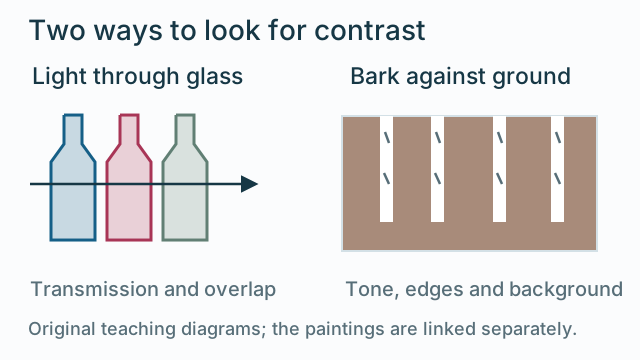
Image note
Historical works: Anjali Arora. These readings use small archived reproductions of White Trees (450 × 222), Purple Flowers (175 × 290) and The Room (313 × 290), alongside the gallery and object captions. The original images remain in their linked archival records; the figure displayed here is an editorial diagram. Capture dates identify saved versions, not the dates of the paintings.


Source
- Artist’s gallery captions and object links, captured 20 August 2015.
- Still life with bottles (gallery caption: Wine Bottles) — individual object card, captured 23 March 2008.
- Path — individual object card, captured 23 March 2008.
- Purple Flowers — individual object card, captured 23 March 2008.
- White Trees — individual object card, captured 23 March 2008.
- Woods — individual object card, captured 23 March 2008.
- The Room — individual object card, captured 23 March 2008.
- Still-life with beer — individual object card, captured 23 March 2008.
- Exoras — individual object card, captured 23 March 2008.
Continue with painting and digital experiments or My Two Worlds.
Independent series: Botanical Study and Studio Corner
The illustrations below are independent studies of light and open space, made for the current edition. They are separate from the archived paintings discussed above.
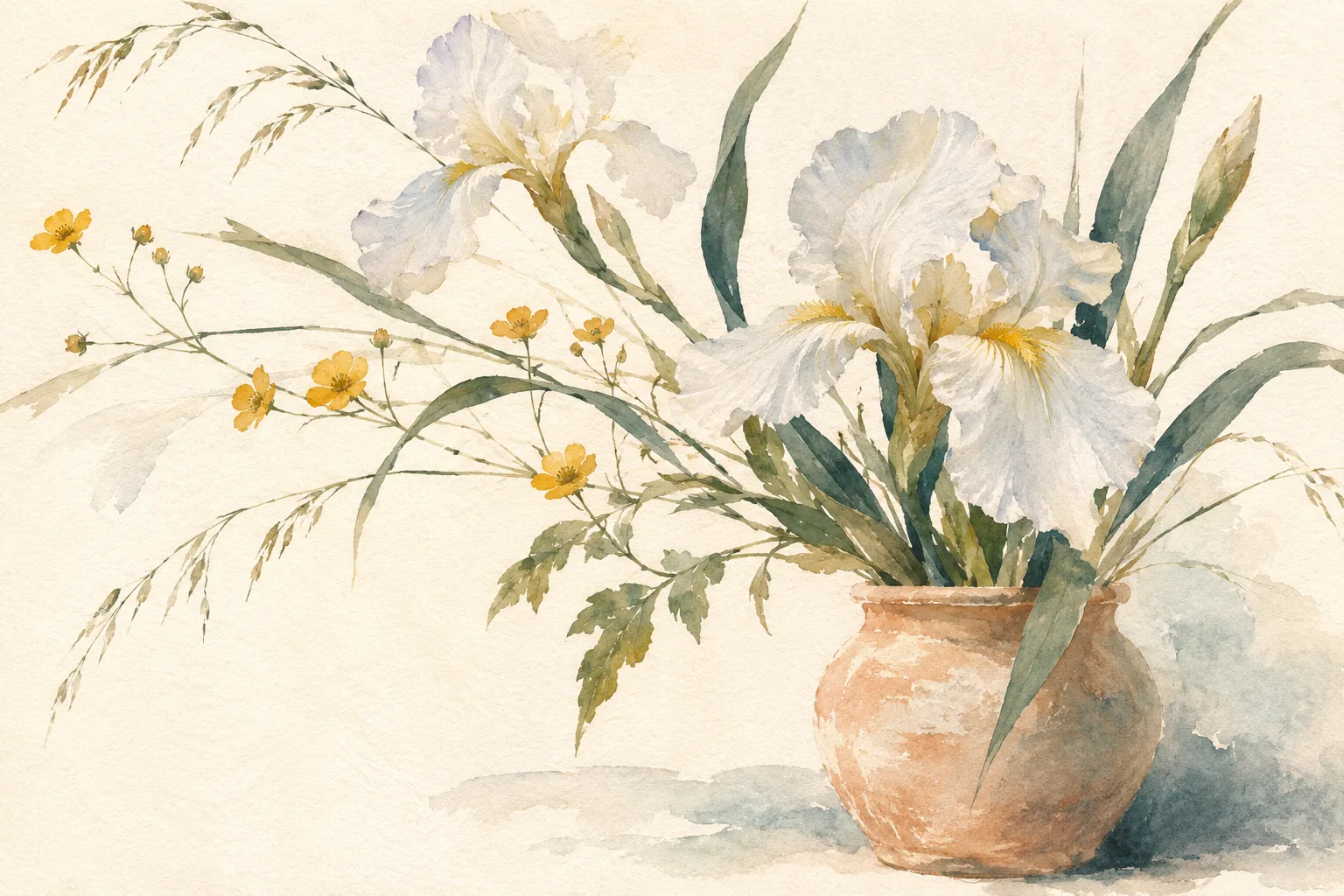
Here the vessel gathers weight towards the right while loose stems carry the eye into open paper. The light margin belongs to the composition as much as the painted flowers: adding detail everywhere would change that balance.
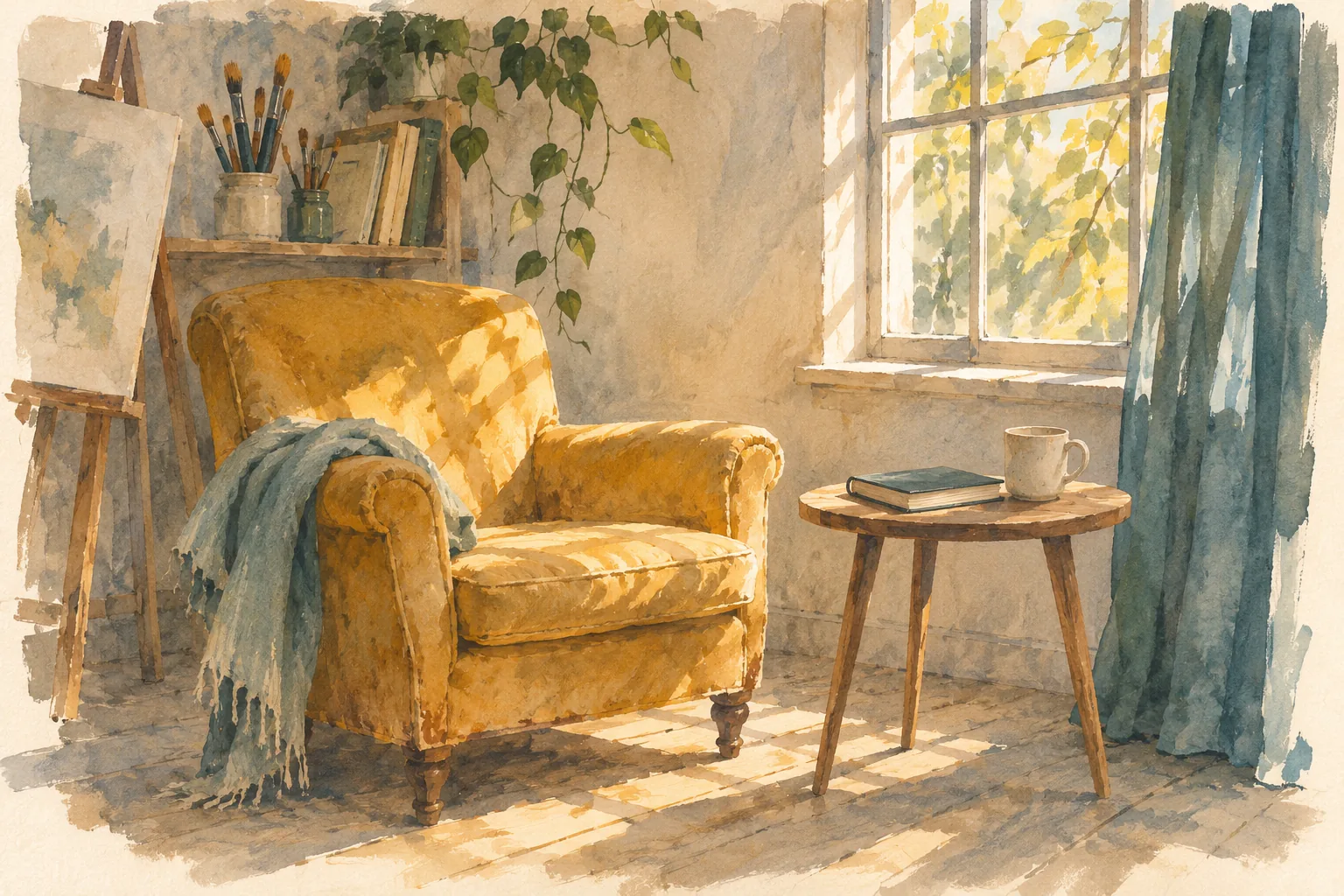
The studio study uses a different arrangement. The ochre chair holds the foreground, a narrow teal curtain gives a cool vertical accent, and window light crosses the floor between them. Compare that warm-and-cool division with the botanical study’s alternation of pigment and unpainted space.