
Urban Lullaby: Reading Silence Through a Small Gesture
Urban Lullaby turns an expected comfort into a source of unease: the speaker is tired, yet quiet prevents sleep. The entrance makes that reversal readable through words and small visual responses. Its useful design question is how a gesture changes attention without becoming the whole meaning of the poem.
Three phrases ask for a pause
The entrance captured on 14 February 2002 carries a 2001 credit to Anjali Arora. Its speaker misses the familiar mixture of city sounds. Three phrases have image-swap instructions on pointer hover; moving away restores the previous image. The phrases concern restless movement, oppressive silence and the desired urban lullaby. A numbered link leads onwards. These controls document visual changes, not an established sound player. The preserved trAce Assemblage catalogue lists the work among Arora’s projects. The source code establishes the three triggers; it does not establish what a present-day reader would hear or how every later page behaved.
The repeated gesture does not repeat the meaning
The three phrases share the same recorded control pattern: hover requests a new image; leaving restores the previous one. The literary work lies in the different thing each phrase asks that pattern to carry.
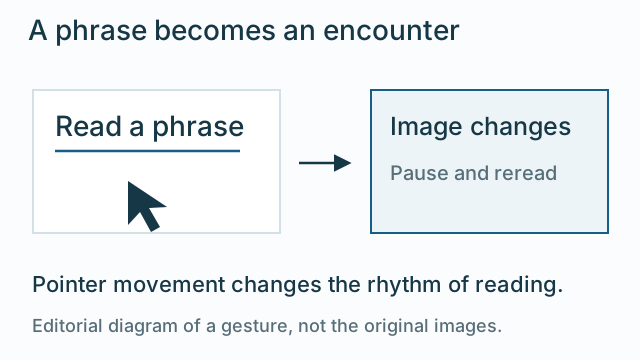
- Restless body: “Toss & turn” requests an image change. The interrupted line can echo the failure to settle; the reader’s brief pause is at odds with the movement it names.
- Quiet becomes the problem: “hear the heavy silence?” asks for another image. A visual response draws attention to an absence described in words. It supplies no evidence of a playing audio track.
- Desired background: “urban lullaby” requests a change again. This time the phrase names the missing comfort. Ordinary city noise becomes something the speaker wants returned.
The annotation has a result: all three gestures can be described with the same control pattern, while their literary jobs differ. The first concerns bodily restlessness, the second recognition and the third desire. Identical mechanics need not make identical meanings.
Quiet is the disturbance
A lullaby usually promises sleep through a gentle, repeatable sound. Here the speaker misses the noisy city; silence has become oppressive. The ordinary opposition between noise and comfort is reversed before any image changes. That is why I read the small interruptions as changes of emphasis rather than the entire poem.
The entrance’s words already give restlessness, a troubling quiet and a desired urban background. The image-changing phrases interrupt those words just as settling down keeps failing. Another reading could treat the controls as invitations to explore rather than enactments of sleeplessness. Both begin with the same source; neither requires an undocumented audio track.
For another relationship between place and attention, read My Two Worlds. Compare the poem’s brief pauses with the movement between public and private gallery scenes in Welcome to the Met.
Sources
- Urban Lullaby entrance — capture of 14 February 2002
- The NEXT — preserved trAce Assemblage catalogue
The phrase-by-phrase interpretation and diagram belong to this edition. The saved entrance supplies the trigger text and image-swap instructions; it is not replayed here.