
A Jolt from Deep Within: Reading the Earthquake Sequence
The saved sequence moves from everyday ease into rupture, then through destruction, help and uneasy social judgement. Its argument is carried by changing text, cut-out photographic fragments and time allotted to reading.
Introduction and examined sequence
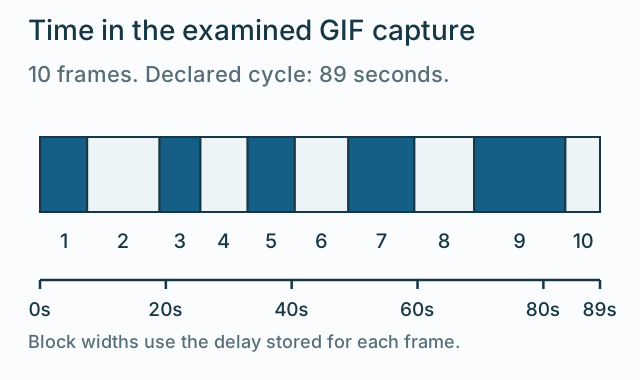
Anjali Arora’s 2001 introduction connects the work to her experience of the Gujarat earthquake on 26 January 2001 and describes an animated GIF requiring the viewer’s attention. Its heading names A Jolt from Deep Within; the document title uses Deep Below. All ten frames of the examined January 2002 GIF capture were inspected for this reading. That file declares frame delays totalling 89 seconds per cycle; this is captured-file timing, not a claim about every historical presentation. Whitney Artport’s Idea Line lists the address under When the Earth Trembled.

The break changes the act of reading
The opening uses widely spaced lettering to describe an unhurried ordinary day. The next frame enlarges key words around the onset of the earthquake. Read together, the two make the change of pace visible in typography: the reader moves from an extended description of routine to a forceful announcement of interruption.
Subsequent frames combine irregular photographic fragments of damaged structures and people with blocks of text. Rather than supplying a continuous pictured space, the fragments ask the eye to move between separate pieces. In this reading, the broken layout gives the language of rupture a second, visual form.
The aftermath is not a simple recovery arc
The later sequence places survival, aid and solidarity alongside fear and exploitative behaviour. That juxtaposition matters more than a single reassuring ending. Shared danger does not produce a uniformly generous society; the work keeps contrary responses within the same account.
The closing frame’s gratitude can therefore be read as a survivor’s position after those contradictions, rather than as a resolution that erases them. Its meaning depends on what precedes it. Isolating the last frame would lose the sequence’s movement between collective support and social criticism.
Attention has a schedule
The file’s delays are unequal. Its ninth frame, concerned with shared vulnerability and social responses, has the longest declared hold: 14.5 seconds. The final frame has 5.5 seconds. Those timings offer a concrete reason to attend to more than a frame’s dominant phrase: supporting passages need reading time too.
An animated sequence assigns time while the reader decides how to use it. This differs from revealing a reply by pointing at a request or choosing the next museum scene. Here, the critical task is to connect one arriving statement to the memory of the previous one.
For your own sequence note, record an image or layout change, the text it accompanies and the duration encoded for that state. Keep observation separate from interpretation. The ten-frame reading here uses extracted frames and file metadata; it does not describe a timed playback observation.
Sources
- Artist’s introduction, captured 11 September 2001.
- Examined animated GIF, captured 5 January 2002. Ten frames, 375 × 282 pixels; declared delays total 89 seconds.
- Whitney Artport, Idea Line text catalogue.