
Digital Divide: From Connection to Influence
A mouse, a market reversal and a promise of consumer power: read these three stops as a developing argument about who benefits from a network. The connection itself is only the beginning of the question.
Three documented stops
Anjali Arora’s Digital Divide entrance contrasts people with a computer mouse and those without one. Chaos turns to the rise and collapse of technological fortunes. The menu’s next named section, Power Shift, links new access to information with consumer choice, contrasting it with an earlier business order centred on bureaucracy and political influence. All three pages are preserved in 2001 captures. A 2002 exhibition announcement in Nettime lists Arora and the Artbrush address under Globalize. The reading below follows the named sections as an editorial route through their arguments.
Follow the change in what counts as power
1. The entrance makes inequality tangible
The mouse is small enough to be held in a hand, but the opening makes it stand for a large difference in opportunity. That choice compresses a complex argument into a familiar object. It also gives a reader a precise question to carry forward: does possession of an input device adequately describe the power to participate?
2. Chaos unsettles the easy promise
The next stop turns attention from a division between participants and outsiders to instability among technological winners. The interpretive shift is important. If fortunes can collapse inside the supposedly advantaged group, connection alone cannot explain security or lasting benefit.
Read the two stops together rather than treating the second as an unrelated complaint about markets. The entrance offers a sharp border; Chaos makes the fortunate side of that border look less settled. The resulting tension is a productive part of the work’s argument.
3. Power Shift changes the unit of comparison
The third stop moves from access and volatility to the relationship between businesses and consumers. Information and choice become potential sources of leverage. Its contrast with bureaucratic and political influence asks whom a business has reason to satisfy.
That is a more specific proposition than saying technology changes everything. The reader can now ask whether available choices can affect a supplier’s decisions. The route has moved from owning a device to being in a position to make someone respond.
Where the promise becomes demanding
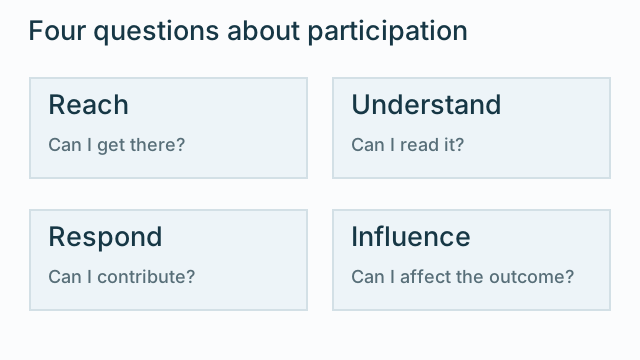
The mouse is a compelling emblem because it makes access look binary. Chaos and Power Shift make the proposition less tidy: being connected is not the same as being secure, and having information is not the same as making a business respond. The work grows more interesting as its opening border becomes inadequate.
I read the three stops as an argument that has to revise its own unit of power. First an object in the hand, then a position in a volatile economy, then a relationship capable of exerting pressure. The promise of connection survives, but it acquires conditions. That movement has more force than a slogan about technology solving inequality.