
Nothing Is Impossible Out Here: A Favour Has Two Stories
A request can sound public-spirited until the reply reveals who benefits. In Nothing Is Impossible Out Here, that gap is both the subject of the satire and the organising principle of its interface.
Requests and replies in the record
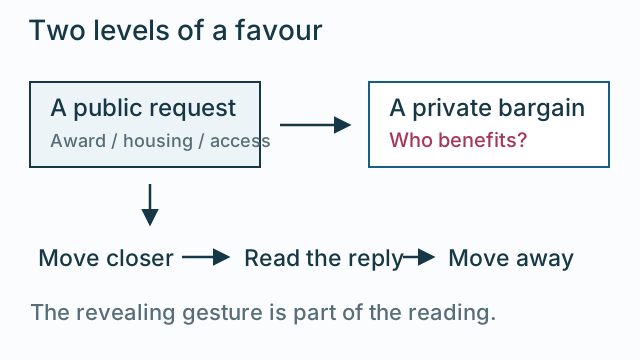
Anjali Arora’s 2001 introduction frames the work as a satire of abuses of power, with India as its immediate reference. The archived handbook pairs requests with concealed replies. An award for a physiotherapist becomes an instruction to reward someone who attends to a minister. Housing for earthquake survivors becomes a roofing order whose supplier dismisses concerns about extreme heat. Another exchange directs an artist towards influential connections. The instructions say that moving the pointer over a left-column link reveals a text layer; moving away hides it. These are fictional exchanges within the artwork, rather than reports of identified transactions.
The award: recognition becomes repayment
Read the award episode in two passes. First consider the request on its own: it asks for public recognition. Now place the reply beside it. The decisive criterion becomes the recipient’s service to a powerful individual. The reply changes the meaning of the request without changing its official-looking purpose.
The satire works through this mismatch of scales. A national honour invokes a broad public, while the explanation narrows the decision to a personal relationship. A reader can locate the problem precisely: the person issuing the instruction controls the decision, while the public meaning of the honour supplies its prestige.
The housing: whose discomfort counts?
The roofing exchange uses a different reversal. Here the request concerns a practical need. The response converts that need into an opportunity for an order, then treats the eventual occupants’ discomfort as negligible. The people most affected are not participants in the bargain.
Compare the two episodes by asking who receives the benefit and who carries the consequence. In the award scene, public recognition rewards a private connection. In the housing scene, a supplier’s opportunity sits beside someone else’s living conditions. This comparison gives the satire a structure beyond a general accusation of corruption: decision, benefit and consequence fall to different people.
Revelation is part of the argument
The pointer instruction makes discovery temporary. Readers must approach a request to bring its second story into view, then keep the pointer there to retain it. Read conceptually, the public statement occupies the stable surface while the compromising explanation needs an act of inquiry.
That is also a tension in the design. A hidden reply rewards curiosity only if the trigger is noticed. Disappearance makes simultaneous comparison harder. I find the instability apt to the subject—the compromising explanation never acquires the security of the public statement—but it also means the satire can be missed. The same gesture supplies the metaphor and its weakness.
The reading of Digital Divide extends the question from access to influence. The imagined museum approaches status through another reversal: paintings discuss the people who normally discuss them.