

FoundIt Tour: A Worked Example of Scope, Tags and Clips
A useful retrieval walkthrough needs a collection, a question and an answer that can be checked. This guide provides all three. The historical mechanisms come first; the complete teaching collection that follows is newly invented.
What the tour actually describes
The December 2006 tour describes movable file-type panels ordered by recency, search within a panel and search across the collection. It names keyword and date controls, text previews and opening files in their native applications. Items can receive multiple tags; selecting a tag displays associated files. The clipping walkthrough selects text from a preview, saves it, optionally adds a tag and shows the clip in the tag-cloud panel with a distinguishing icon. These are described interface mechanisms, not measured retrieval results. The source does not establish that every combination of scope, tags and dates can be applied together. The project overview explains the product’s dates and Google Desktop context.
Five records, one misplaced memory
Every filename, project, tag and passage below is invented for this guide. The labels are a paper model for comparing retrieval routes; they are not undocumented FoundIt search syntax.
- A —
river-sketch.pdf - Project: River. Tag: field-study. Passage: “Three stones mark the east-bank crossing.”
- B —
river-budget.xls - Project: River. Tag: planning. Passage: “Allow two survey days before the bridge workshop.”
- C —
river-notes.txt - Project: River. Tag: field-study. Passage: “The east-bank crossing needs a second visit after rain.”
- D —
museum-plan.pdf - Project: Museum. Tag: planning. Passage: “Place the ticket desk beside the west entrance.”
- E —
invoice-email.eml - Project: Studio. Tag: admin. Passage: “Payment covers one month of studio rent.”
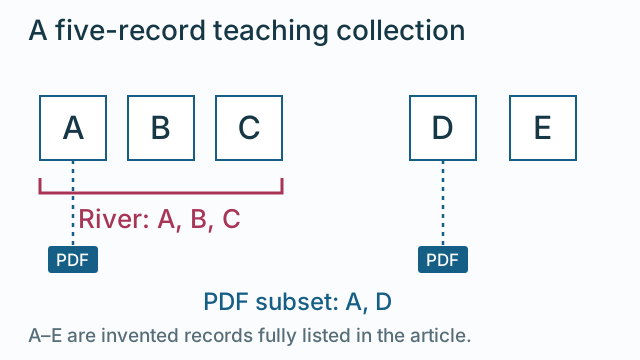
Step 1: test the remembered format
The task is to recover the caution about the river crossing for a workshop brief. You remember seeing it in a PDF. The PDF subset is A and D. D concerns the museum entrance; A concerns the crossing but contains no caution about rain. The first clue has produced a plausible document without producing the wanted passage.
This is a meaningful failure state. Saying “two results” is insufficient: the reader must also know that three records lie outside the current subset. A narrow result list does not prove that the collection lacks the information.
Step 2: change the retrieval question
Set the format clue aside. The project label River retrieves A, B and C, crossing PDF, spreadsheet and text formats. Read those three passages: B supplies a budget assumption, A identifies the crossing and C supplies the rain condition. C answers the question even though its format conflicts with the initial memory.
For comparison, the independent tag field-study retrieves A and C; planning retrieves B and D. Project and activity are different relationships. A planning label is too broad for the crossing question because it also brings in museum work. These are set comparisons within the teaching data, not a claim about combining original FoundIt controls.
Step 3: carry the condition into the clip
Copying only “a second visit” would lose both the location and the reason. Our paper clip therefore keeps the complete passage and adds a short explanation:
The east-bank crossing needs a second visit after rain.
- Source
- C —
river-notes.txt - Context
- River project; field-study tag
- Reason for keeping it
- Preserve the rain condition when planning the next site visit.
This clip record is an editorial proposal. It shows what context a reusable excerpt needs; it does not assert that FoundIt automatically stored these fields. Reading the brief later, someone can identify the source, recover the condition and distinguish it from B’s separate budget assumption.
What the worked example establishes
The PDF route returned a related file and still missed the answer. The River route recovered the relevant text record. The clip then preserved a condition that careless shortening would remove. Those outcomes follow from the fully listed sample data; no user study is needed to verify the set membership.
A real evaluation would add a different question: can people recognise the current scope and make that recovery unaided? Compare the role-based questions in ArchChive and the audience-and-stage grouping example in information design.
Sources
The five-record collection, passages, set comparisons and proposed clip record are current editorial teaching material.