
FlyHi: The Four Cards in a Saved WML Draft
The archive retains an actual FlyHi draft: an entrance, a menu, an empty help card and an untitled call card. Its unfinished links tell a more specific story than the old class label alone.
The saved deck
Mohit SantRam’s assignment dated 28 September 2004 lists this address as “1st Try – Anjali”. A 16 December 2004 capture now supplies the WML source itself. A 3 January 2006 capture contains identical bytes. Capture dates identify saved versions, not an exact creation date.
The source contains four card elements. Three have identifiers: welcome, index and custService. The fourth has no identifier. Its airline-service labels belong to an early draft, rather than an established booking service.
A shared template also declares BACK and HOME softkeys. The HOME markup contains a link to the class’s external Cellphonia contents page. Those declarations belong to the saved source; they do not establish successful navigation on a phone.
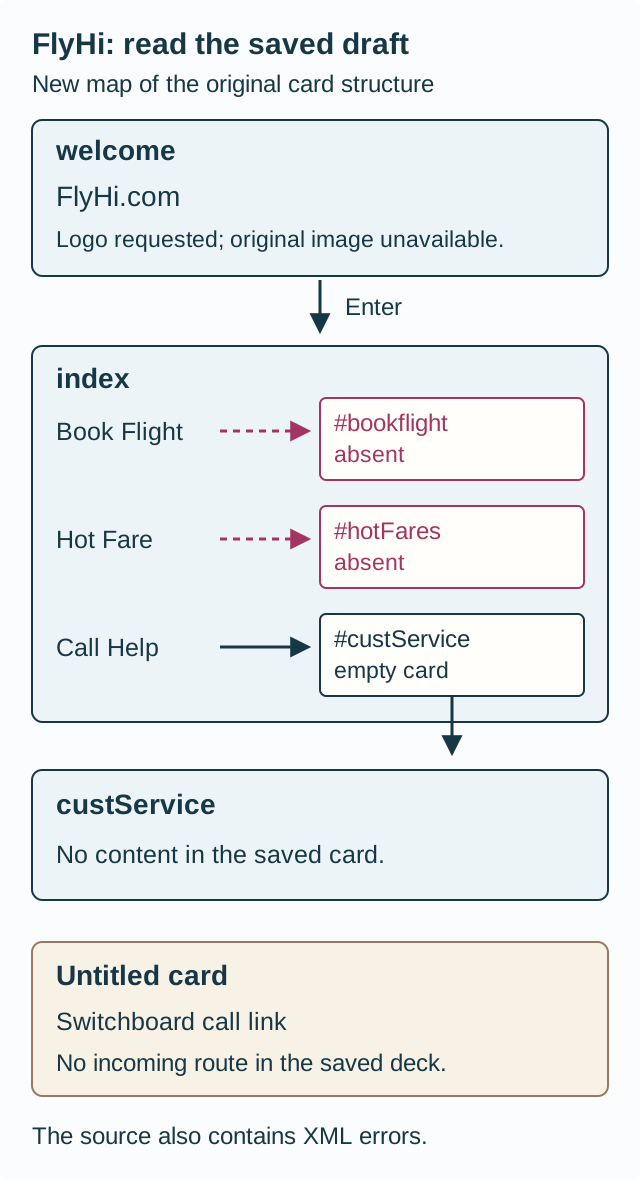
Read the four cards
This HTML reading view follows the saved labels. Its jump links are current browser navigation; it makes no booking and initiates no call.
Entrance: welcome
The opening card names FlyHi.com and requests a logo file, 168.wbmp. The examined archive records for that image return 404, so no substitute is presented as the original logo.
Help: custService
The saved card has no content. Return to the menu reading.
The untitled call card
A separate card contains a customer-service message and a Switchboard link using the WTAI telephone scheme. No menu route points to this card in the saved deck. The telephone action is represented here as text.
The useful failure is specific
The draft has more than missing destinations. An XML parse fails at an unmatched closing tag. Recovering the bytes therefore does not demonstrate successful operation on a historical phone. Silently filling the two missing cards would turn a source into a new design.
A separate FlyHi task-flow page, captured in June 2006, describes route and date choices, confirmation and a customer-service fallback when connectivity is poor. Those are proposed screens in another document. They help trace the idea without supplying the absent cards in this deck.
A separate navigation study
The current edition’s Three cards, four links exercise is an independent paper model. Its complete return paths are useful precisely because they are not borrowed as a missing part of FlyHi.
Sources
- Mohit SantRam — Assignment #5b, 28 September 2004.
- Original WML deck, captured 16 December 2004; identical saved deck, 3 January 2006.
- Separate travel-application task flows, captured 22 June 2006.
The source map and HTML reading view are new editorial work. The historical draft is recovered; its missing image, missing cards and handset operation are not repaired or claimed.